
Retailers have never planned this early for peak, yet most of them still expect to be scrambling once it hits.
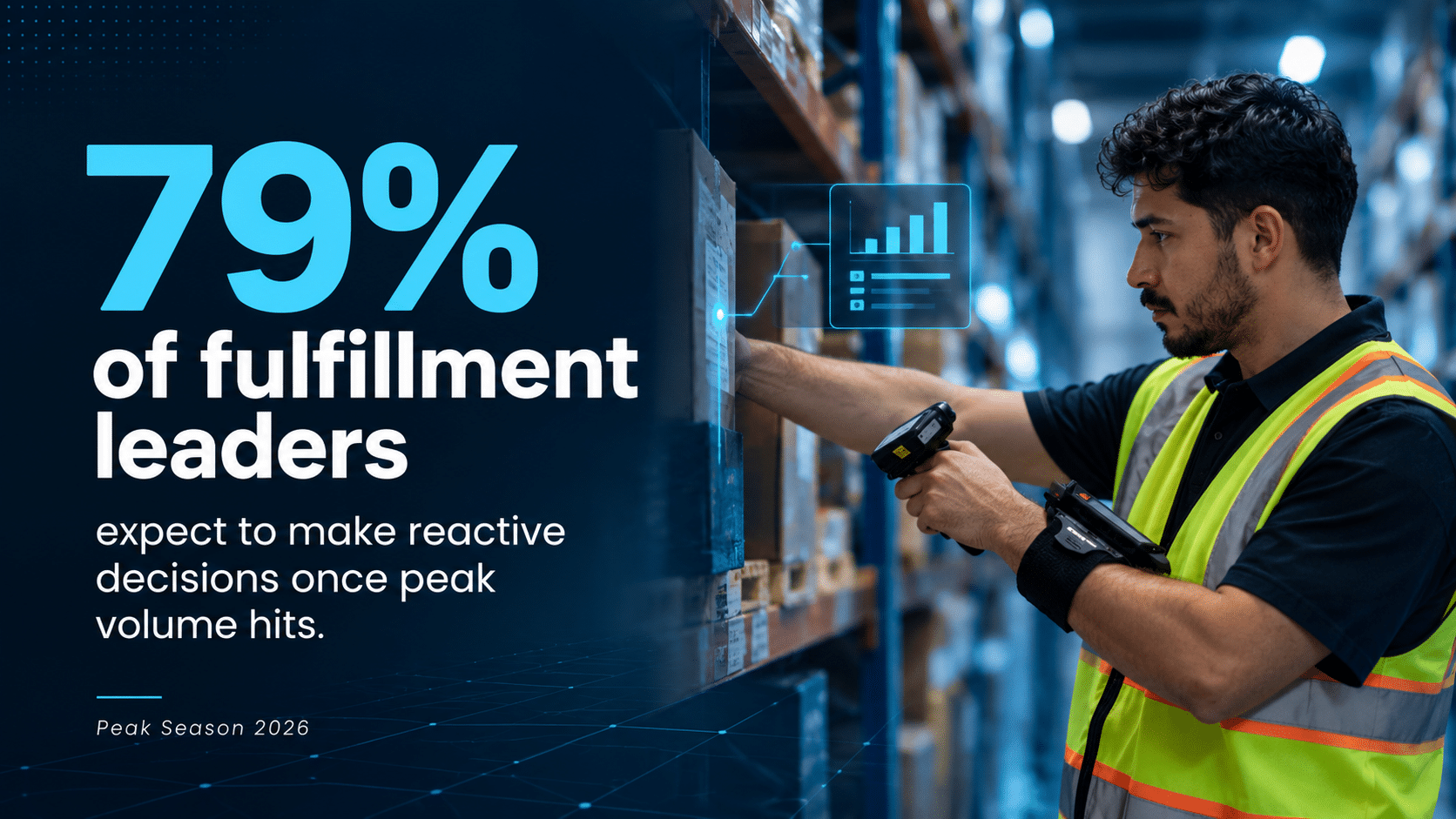
In a recent survey of 328 fulfillment leaders, 96% said they started planning earlier this year. Yet 79% expect to make reactive decisions once volume spikes. That’s not a contradiction. That’s peak season.
Shoppers are changing how they discover products, what they’re willing to pay, and what they expect after they click “buy.” Promotions start earlier and run longer. And the warehouse has to adjust to all of it.
Here are six trends shaping peak season 2026, and what each one means on the warehouse floor.
1. Peak season is longer, but the spikes are still sharp
Adobe forecasts $275.1 billion in U.S. online holiday sales for November and December, up 6.7% year over year. October alone is expected to hit $95.8 billion, up 8%.
So peak starts earlier. But it doesn’t flatten out. Cyber Week is still projected at $47.5 billion, about 17% of the entire two-month season. Black Friday is expected to grow faster (9.2%) than Cyber Monday (6.2%).
What it means for the warehouse: A longer peak is not easier. It’s a series of promotions, each with its own surge. Operations need to shift priorities, replenishment, and labor from one wave to the next, not just staff up for one big week. That’s a job for AI-powered orchestration software, not spreadsheets. inVia Logic, an AI-enabled warehouse execution system (WES), schedules tasks and adjusts priorities every few seconds. It tells each associate what to do next and helps improve forecasting, so the operation shifts with each wave instead of after it.

Traditional task scheduling vs. inVia Logic’s dynamic, demand‑driven task scheduling.
2. Shoppers will spend, but they’re watching every dollar
In Kenco’s 2026 Peak Season Consumer Report, 43% of respondents plan to spend more this year and 39% about the same. But 59% name pricing and inflation as their biggest concern, and 45% point to tariffs as a driver of higher prices.
Peak isn’t only about gifts anymore. Adobe expects shoppers to use Cyber Week deals to stock up on everyday items. Compared with average September sales, clothing basics are projected up 210%, personal hygiene 150%, and pet products 93%.
What it means for the warehouse: More orders, lower-margin items, and a broader mix of SKUs. The operations that protect their margins through peak season treat every extra touch, every extra walk, and every mis-pick as the real cost. Here, automation works on two fronts. inVia PickerWall goods-to-person robots bring inventory to the picker instead of sending people down the aisles, while the inVia Logic WES batches orders intelligently and keeps replenishment and putaway ahead of demand. At peak volume, a holistic approach to warehouse optimization and automation makes the biggest impact.

inVia PickerWall goods-to-person picking
3. Free, fast, and trackable: the same promises, higher stakes
Shopper expectations haven’t really changed in years. What’s changed is how little patience there is when they aren’t met.
Among Kenco’s respondents:
- 73% consider free shipping standard
- 48% expect two-day delivery
- 40% expect real-time tracking
- 82% say the return policy matters when choosing where to shop
- 24% say one bad return experience could make them stop buying from a retailer
And when an order is late, shoppers mostly want to know. 35% want an updated delivery date, 29% want a proactive heads-up, and 29% want an explanation.
What it means for the warehouse: The goal isn’t speed at any cost. It’s reliable service at a cost you can sustain. That means picking, replenishment, packing, and order prioritization working together, plus enough visibility to catch exceptions before they become broken promises. That’s a lot of decisions. A warehouse manager can realistically make about 200 well-informed decisions a day. inVia Logic, our AI-powered warehouse execution system (WES), makes roughly a million, constantly balancing orders, inventory, people, and robots to keep productivity up and promises on track.
4. AI and social are changing how shoppers find products
Adobe expects traffic from AI assistants to U.S. retail sites to grow 130% year over year this holiday season. In its July survey, shoppers who had used AI to shop said they felt more confident in their purchases (77%) and less likely to return them (69%).
Kenco found 60% of respondents likely to use AI tools for holiday shopping. More than half expect at least a fifth of their gifts to be bought directly through social platforms.
Marketers have spent the last decade chasing shoppers across every new channel: search, marketplaces, apps, influencers, and now AI assistants. But a new channel only changes how the order arrives. It doesn’t change what happens after.
What it means for the warehouse: Discovery is getting more fragmented and harder to predict. Fulfillment still has to deliver, whichever door the order came through. Marketplace, website, social, or AI assistant, every order lands in the same queue. inVia Logic prioritizes all of it in real time, so fulfillment stays consistent even when demand doesn’t.
5. Everyone planned earlier. Most still expect to react.
This is the trend that matters most for operations.
Kase and research firm TrendCandy surveyed 328 retail and e-commerce fulfillment leaders. 93% expect peak demand to increase, 96% started planning earlier, and 85% are building inventory ahead of peak. And still, 79% expect to make reactive decisions once volume hits. Only 61% say they’re very confident they can meet demand.
The top operational risk? Inventory imbalance, named by 52%.
What it means for the warehouse: Planning sets the baseline. Execution decides how well you adapt when the plan meets reality. Stocking more inventory doesn’t help if it’s in the wrong place, or if the operation can’t re-prioritize work in real time when demand shifts. That’s the gap orchestration closes. Twin IQ digital twin simulations let you test your layout against historical peak data before the rush hits. Once volume arrives, inVia Logic re-prioritizes work as demand changes and keeps replenishment ahead of picking, so the right inventory is in the right place before it’s needed.

Twin IQ simulation: idealized slotting vs. actual SKU density on a simulated production day.
📊 Check your peak readiness: Want to see how your floor will handle the surge?
Ask us about a Twin IQ simulation for your facility.
6. Automation is growing, but most warehouses are a mix
The “lights-out” warehouse makes a great headline, but it’s not what most operations look like.
In Modern Materials Handling’s 2026 Automation Study, only 12% of respondents describe picking as fully automated, and 9% say the same for replenishment. Meanwhile, 48% already use goods-to-person picking, and 51% plan new or upgraded goods-to-person deployments in the next two years. 38% use a warehouse execution system (WES).
What buyers care about is telling: 92% rate reliability and uptime as very important, ahead of purchase price at 78%. Inbound Logistics’ 2026 technology coverage points the same way: a shift toward modernizing existing buildings rather than starting over.
What it means for the warehouse: The real job is coordinating people, robots, and software in the building you already have. Better peak performance doesn’t always mean a new warehouse. Often it means getting more out of the one you’ve got. That’s the idea behind a phased approach. inVia Logic works with the WMS and systems you already run, and coordinates people and robots on the same floor. PickerWall can be added one workflow at a time, and with flexible Robotics-as-a-Service (RaaS), you can scale autonomous mobile robots (AMRs) up for peak season without a big upfront capital investment.

inVia Logic warehouse execution system
The common thread: peak is won in execution
Put the six trends together and a pattern shows up. Shoppers want the same things they’ve wanted for years: a fair price, free shipping, fast delivery, and easy returns. What’s changed is everything around those promises. More channels. Longer promotions. Sharper spikes. Tighter margins.
Most retailers aren’t short on planning. They’re short on the ability to adapt once the plan meets real volume.
That’s where orchestration comes in. inVia Logic, our AI warehouse execution software, makes roughly a million fulfillment decisions a day: which order to pick next, which robot or person should handle it, when to replenish, and what to prioritize when something changes. It works across people, robots, and the systems you already run, so the operation can adjust in real time instead of after the fact.
Peak season will always bring surprises. The goal is an operation that can absorb them.
💡 Ready for peak season? See how inVia Logic could fit your operation. Talk to our team.
Key Takeaways for Warehouse Leaders
- Peak seasons are stretching out: Spreadsheets aren’t enough. AI-driven warehouse execution systems (WES) shift priorities dynamically across back-to-back sales waves.
- Margins are tightening: As consumers stock up on low-margin basics, goods-to-person robotics like inVia PickerWall, orchestrated by a WES, protect profitability by cutting extra touches, walking, and mis-picks.
- Planning isn’t enough: 79% of fulfillment leaders expect to make reactive decisions once volume hits, so real-time orchestration matters as much as the plan.
- AI and social commerce drive volatility: No matter where an order comes from, unified software orchestration is what keeps 2-day delivery promises.
- Automation must be flexible: Upgrading existing facilities in phases with Robotics-as-a-Service (RaaS) lets you scale for peak without massive upfront CapEx.
Sources
- Adobe, 2026 U.S. Holiday Shopping Forecast (September 28, 2026)
- Kenco, 2026 Peak Season Consumer Report and news release (350+ North American consumers)
- Kase and TrendCandy, 2026 Peak Season Retailer Sentiment Survey (328 fulfillment leaders), with findings from 9 Peak Season Predictions for Retail and Fulfillment in 2026 and Peak Season 2026 Planning Starts Before the Holiday Rush
- Modern Materials Handling and Peerless Research Group, 2026 Automation Study
- Inbound Logistics, Top Supply Chain Technology Trends Reshaping Logistics in 2026