
Most warehouse operators assume “automation” means a massive fulfillment center: fleets of robots moving through aisles, carrying pallets, racks, or totes around the clock. Because of that image, many mid-sized operations disqualify themselves before they even start the conversation:
“We’re not big enough for that.”
But square footage alone does not determine whether automation makes sense. A smaller warehouse often has the most to gain.
And automation isn’t just robots. It doesn’t require a seven-figure capital investment to start, either. Real automation can begin with AI-enabled warehouse execution software (WES) that helps prioritize work, direct people and equipment, and keep orders moving through the operation.
The Assumption That’s Costing You Money
Warehouse automation has a visibility problem. Headlines tend to focus on the biggest deployments: massive fulfillment centers, hundreds of robots, and nine-figure investments. That can make automation look like a Fortune 500 game.
But the most relevant automation for many mid-sized warehouses looks very different. A warehouse with a relatively small footprint and a lean picking team still experiences daily friction from manual decision-making, shifting order priorities, and peak-volume pressure.
For many smaller operations, automation can start with an AI-enabled warehouse execution system (WES), like inVia Logic, or a small, targeted fleet of autonomous mobile robots (AMRs) to offset labor shortages.
inVia Logic WES helps orchestrate tasks in real time. It decides what should happen next, prioritizes high-velocity tasks, and directs people or equipment as conditions change on the floor. Sitting between your existing Warehouse Management System (WMS) and the floor, a WES translates static inventory and order data into dynamic execution.
The question is not whether your operation is large enough to “have automation.” It is whether your current way of managing work is creating avoidable cost, delay, and complexity.
💡 Quick Assessment: Want to see how much labor travel your facility can eliminate?
See How inVia Logic Works for Mid-Market Warehouses
How Small Is Too Small for Warehouse Automation?
Square footage is often the first filter companies use when they start talking about warehouse automation. Industry guidance often suggests minimum facility sizes for AMRs or automated storage. That is understandable. Physical automation has physical requirements: enough aisle space, sufficient clear height, and a safe operating environment.
But floor space is only one input. It should not be the first (or only) one.
The more useful question is: What does it cost to fulfill your current order volume today, and where is that cost coming from?
When evaluating automation, companies should begin with three operational realities:
-
Order Profile & Velocity: Look at daily order volume, average order size, and peak-period demand. A stable full-pallet operation has very different needs from a high-SKU, each-pick operation.
-
SKU Complexity & Travel Distance: Review active SKUs, item velocity, and pick-location strategy. The real issue is often how far people must travel to complete an order.
-
Labor Profile & Exception Handling: Understand how much time is spent picking, replenishing, and managing exceptions. Include overtime and temporary labor, not just headcount.
Labor is commonly one of the largest warehouse operating costs, making this analysis more useful than a simple building-size comparison. A warehouse may be small in square footage but expensive to operate. That is where the automation conversation should start.
Data Visibility: Uncovering Hidden Inefficiencies
There is another critical part of the automation conversation that rarely gets enough attention: data that let’s your look under the hood of your operations. When you run a manual warehouse, managers spend all day playing firefighter, trying to figure out why pickers are backed up or why throughput slowed down.
An AI-driven WES changes that dynamic entirely. Because inVia Logic WES orchestrates floor resources, sequences tasks, and balances workloads dynamically, it handles and resolves bottlenecks automatically as conditions change. The software keeps work moving. But the data it continuously captures in the background does something even more valuable: it uncovers hidden physical and operational inefficiencies you didn’t know were there.
By tracking micro-movements, scan times, and task flows down to the second, the system identifies deeper issues—like overstuffed pick faces, poor item slotting, or physical bin placement that creates friction for pickers.
This level of intelligence isn’t limited to massive distribution hubs. Smaller operations gain tremendous leverage from understanding how work flows through their building—and pinpointing the exact root cause behind floor delays.
📖 Dig Deeper: Curious how AI tracks daily micro-movements to spot hidden operational bottlenecks? Read our full breakdown:
How inVia Logic Finds and Solves Warehouse Inefficiencies You Didn’t Know Were There
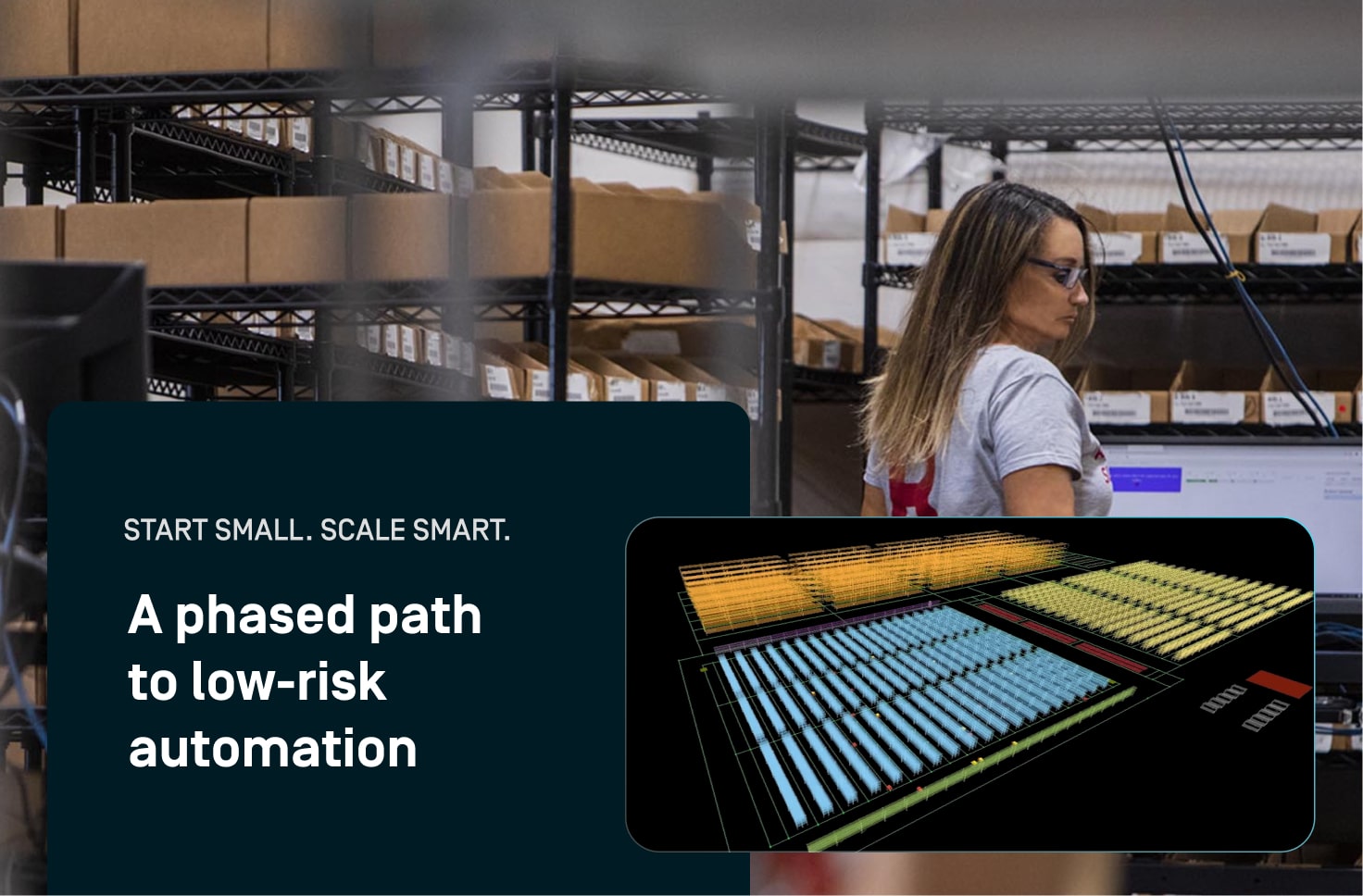
A Phased Framework for Low-Risk Automation
The strongest automation strategies do not begin with a massive technology purchase. They begin with an operational constraint.
For one warehouse, the best first step may be establishing true data visibility and task orchestration through WES software. For another, it may be adding pick-to-color interfaces or introducing mobile robots to reduce picker travel.
By starting with software, you get immediate baseline metrics without manual audit spreadsheets:
| Phase | Focus | Goal | Primary Technology |
|---|---|---|---|
| 1. Establish Baseline | Data Capture | Deploy WES to automatically measure throughput, labor hours, travel paths, and error rates in real time. | AI WES Software (inVia Logic) |
| 2. Optimize Execution | Task Orchestration | Dynamically route pickers, optimize order batching, and balance workloads to maximize current staff output. | AI WES Software (inVia Logic) |
| 3. Automate Constraints | Targeted Hardware | Introduce autonomous mobile robots (AMRs) to handle high-density travel and repetitive retrieval tasks. | Autonomous Mobile Robots (inVia Picker) |
| 4. Scale Deliberately | Flexible Expansion | Expand robot fleets seamlessly during peak demand based on proven ROI without CapEx risk. | Robotics-as-a-Service (RaaS) |
Start with a defined problem, let the software measure the true baseline, and then expand. A phased approach helps companies target a constraint before committing to a broader physical automation program.
This does not mean every company must buy software before it buys robotics. Some operations have a clear material-flow problem that requires physical automation right away. But robots cannot compensate for unclear processes, inaccurate inventory data, or unmanaged exceptions.
So, Are You Too Small for Automation?
Probably not—but that does not mean every automation technology is right for your operation today.
If manual coordination is slowing down work, if picker travel is consuming too much time, or if peak demand creates overtime and backlog, it is worth evaluating automation.
Start with the data:
- Measure order volume, peak demand, and labor travel hours.
- Identify where travel, errors, or delays are occurring on the floor.
- Calculate the cost of the bottleneck.
- Choose the smallest change—software or hardware—that can improve it.
The real question is not whether you are big enough for automation. It is whether you understand where the operation is losing time and money—and what the right first improvement looks like.
Key Takeaways for Warehouse Leaders
- Facility size isn’t the blocker: High SKU density, picker travel time, and peak-volume friction matter far more than raw square footage.
- Automation isn’t just physical hardware: You can begin automating immediately with an AI-driven Warehouse Execution System (WES) like inVia Logic to optimize workflows using your existing team.
- Phased adoption minimizes risk: Implementing software-guided execution first creates a solid foundation before adding autonomous mobile robots (AMRs) through flexible models like Robotics-as-a-Service (RaaS).